
Function before finishes
We first consider movement, storage, reach, clearances, daily routines, cleaning, and access. Beautiful finishes perform better when the underlying layout supports the people using the space.
July 2026 · AA Advanced Home Solutions
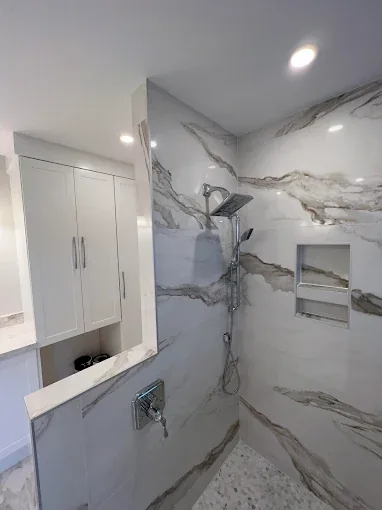
Bathrooms don't usually fail all at once — they wear down gradually, until one day you notice the grout is cracking, the vanity feels dated, or the shower just never quite drains right anymore. Here are the signs worth paying attention to.
Any discoloration around the toilet, tub or shower base, or a floor that feels slightly soft underfoot, usually points to water intrusion somewhere behind the surface. In South Florida's humidity, small leaks turn into larger problems faster than in drier climates, so this one is worth addressing sooner rather than later.
If you're re-caulking every few months and the grout still looks discolored no matter how much you scrub, the waterproofing underneath may no longer be doing its job. That's a renovation issue, not a cleaning-product issue.
Bathrooms designed decades ago often have cramped vanities, awkward door swings, or a tub nobody uses. If you find yourself working around the room instead of the room working for you, that's a sign the layout itself needs to change, not just the finishes.
If the mirror fogs for twenty minutes after every shower and the exhaust fan barely moves air, moisture is sitting in your walls and ceiling longer than it should. Over time that leads to mold and deteriorating drywall — a bigger fix than replacing a fan.
Sometimes there's no damage at all — the bathroom is just stuck in whatever decade it was last touched, while the rest of the home has moved on. That's a valid reason on its own, especially if you're planning to sell in the next few years.
If any of these sound familiar, it's worth having someone take a real look rather than guessing. A quick inspection can usually tell you whether you're looking at a simple refresh or something more involved.
Get a free written estimate from AA Advanced Home Solutions.
A successful bathroom remodel is not only about selecting attractive finishes. It requires a clear plan for how the room will function, how the work will be sequenced, and how every visible choice connects to the underlying construction. AA Advanced Home Solutions provides bathroom remodeling in Broward County with an emphasis on practical design, organized execution, and durable materials suited to South Florida homes.
Broward County includes homes and condominiums across Fort Lauderdale and surrounding South Florida communities. Because no two properties are identical, we do not treat local remodeling as a one-size-fits-all package. Existing dimensions, slab and wall conditions, plumbing or electrical locations, access, neighborhood rules, condominium requirements, and the homeowner's priorities all influence the right scope.
Before construction begins, the project should account for showers, tubs, vanities, tile, lighting, ventilation, plumbing fixtures, storage, waterproofing, and safer everyday access. These elements affect one another. A layout change can alter lighting and electrical needs; new cabinets or built-ins can affect flooring sequence; plumbing changes may influence wall repairs and tile; and appliance or fixture selections can change clearances. Planning these connections early helps create a bathroom that is easier to maintain, more comfortable to use, and better suited to the household.
We first consider movement, storage, reach, clearances, daily routines, cleaning, and access. Beautiful finishes perform better when the underlying layout supports the people using the space.
South Florida humidity, sunlight, water exposure, pets, children, entertaining, and maintenance preferences all matter. Material recommendations should reflect how the home is actually used.
Demolition, repairs, rough plumbing and electrical work, surfaces, fixtures, cabinetry, flooring, paint, and final details must happen in the right order. Coordination protects both quality and schedule.
We begin by discussing what is not working, what you want to change, and how the space is used. For Broward County properties, the review also considers access, existing construction, utilities, building or association requirements when applicable, and the conditions that may affect the scope.
The project is organized around the required work rather than a vague allowance. We identify the major components—showers, tubs, vanities, tile, lighting, ventilation, plumbing fixtures, storage, waterproofing, and safer everyday access—and discuss which choices have the greatest effect on price, lead time, maintenance, and appearance.
Before demolition, dimensions and selections should be confirmed, long-lead products ordered, permit needs reviewed, and the work sequence planned. This preparation reduces avoidable delays and helps homeowners understand what will happen next.
Work proceeds in a logical order, with protection of adjacent areas, trade coordination, progress communication, and attention to the details that affect the finished result. Any requested changes should be documented so their cost and timing are clear.
At completion, the work is reviewed for remaining details, function, finish quality, and cleanup. Homeowners should also receive practical guidance about care and maintenance for the installed materials.
There is no responsible single price for every bathroom remodel. The investment depends on the size and condition of the space, demolition, structural or utility changes, product quality, custom fabrication, site access, permit requirements, finish complexity, and how much of the existing room can remain. A detailed scope is more useful than a broad online average because it shows what is—and is not—included.
Homeowners can make better budget decisions by identifying priorities early. Spending more on the elements that are difficult to replace later, while simplifying decorative items that can be updated more easily, often creates a stronger long-term result. Early selections also reduce last-minute substitutions and schedule disruptions.
Depending on the scope, a remodel may involve permits or inspections for structural, plumbing, electrical, mechanical, gas, roofing, or other regulated work. Condominium and homeowners' associations may also require applications, insurance documents, approved work hours, elevator reservations, or material specifications. Requirements vary by jurisdiction and property, so they should be confirmed for the actual project rather than assumed.
Our goal is to make the remodeling process easier to understand from the first conversation through final completion. We focus on a defined scope, practical recommendations, local communication, and craftsmanship that supports both appearance and daily use. Whether the project is a focused room update or part of a broader home renovation, we help connect design decisions to the work required to build them correctly.
Timing varies with the room size, inspections, material availability, waterproofing, tile complexity, and whether plumbing or walls are relocated. We provide a project-specific schedule after the scope is defined.
That depends on condition and goals. Common updates include the shower or tub, waterproofing, tile, vanity, countertop, fixtures, lighting, ventilation, flooring, paint, and storage.
A properly built shower requires a complete water-management system behind the finished tile. The visible tile and grout are only the finish layer; the substrate, membrane, transitions, drain, and penetrations must be handled correctly.
Yes. Curbless or low-threshold entries, handheld shower fixtures, appropriate blocking for grab bars, improved lighting, slip-conscious flooring, wider clearances, and comfort-height fixtures can all improve usability.
Permit requirements depend on the work. Plumbing, electrical, structural, ventilation, and layout changes may require permits or inspections. The correct requirements should be confirmed for the property and scope.